Why Is John So Different from Matthew, Mark, & Luke? A Narrative & Theological Guide
If you have read Matthew, Mark, or Luke and then opened John, you know the feeling.
Something shifts. The air changes. The pace changes. The kinds of things Jesus says change. The parables that fill the Synoptic Gospels — the prodigal son, the good Samaritan, the mustard seed — are absent. The long discourses that define John’s Gospel — the Farewell Discourse, the Bread of Life teaching, the vine and the branches — do not appear in Matthew, Mark, or Luke. The Sermon on the Mount is in Matthew but not in John. The raising of Lazarus is in John but not in the others.
The question is natural and important: why is John so different? Did he write a different kind of book on purpose? Did he have different sources? Was he responding to something the other three had left out?
The answer is yes to all three — and understanding why makes the whole Gospel more readable.
The Short Answer: Why John Wrote Last and Chose Differently
John’s Gospel was written last — scholars generally date it to around AD 85–90, at least a decade after Matthew, Mark, and Luke had been circulating through the early Church. John almost certainly knew those accounts existed. He chose to write anyway, and he chose to write something different.
His purpose was not to repeat what had been said but to go deeper. Matthew, Mark, and Luke — called the Synoptic Gospels because they see the story from a similar angle — give us the narrative of Jesus’ life and ministry with a shared structure: baptism, Galilean ministry, journey to Jerusalem, Passion and resurrection. They share large amounts of material, sometimes word for word.
John shares almost none of it. Over ninety percent of John’s content is found nowhere in the Synoptics. He is not retelling the same story in a different style. He is giving us a different selection of events, different conversations, different moments — chosen deliberately to make a theological argument that the other three Gospels do not make in the same way.
He states his purpose explicitly near the end: these things are written so that you may believe that Jesus is the Christ, the Son of God, and that by believing you may have life in His name. John is writing a case for belief. Every scene he chooses, every conversation he records, every miracle he calls a sign — it is all evidence, carefully arranged, pointing toward a single verdict about who Jesus is.
The Deeper Answer: 5 Key Differences Between John and the Synoptic Gospels
To move beyond the timeline is to see that John is doing something fundamentally different than Matthew, Mark, or Luke. Where the Synoptics give us a portrait drawn from the ground up—recording parables, Galilean journeys, and historical milestones—John paints from heaven downward. He leaves out familiar parables and public sermons not by oversight, but by deliberate design.
Explore the five defining structural and theological shifts that set the Fourth Gospel apart:
-
Matthew begins with Abraham. Luke begins with the announcement to Zechariah. Mark begins at the Jordan River. John begins before the universe existed. In the beginning was the Word. No other Gospel opens at the beginning of time. John makes this claim in the first sentence, while the others do not make it until much later, if at all: Jesus is not merely a human being chosen by God. He is the eternal Word of God, through whom all things were made.
So loved. The Greek word is houtos — in this way, to this extent, in this manner. God loved the world in this way: that He gave. The so is not merely an intensifier. It points to what follows as the measure and the evidence of the love. You want to know how much God loves? Look at what He gave.
-
The Synoptics record many more miracles than John — dozens of healings, exorcisms, nature miracles. John records seven, and he never calls them miracles. He calls them signs. The word is deliberate: a sign points beyond itself to something it signifies. In John’s Gospel, what Jesus does always points to who Jesus is. The water becoming wine at Cana is not just generosity. It is a sign that the age of ritual purification is giving way to the age of grace. The healing of the man born blind is not merely an act of compassion. It is a sign that Jesus is the light of the world.
The universality is not incidental. John’s Gospel has been gesturing toward it since the Prologue — the true light enlightens everyone, the Logos enters His own creation, He gives power to become children of God to all who receive Him. John 3:16 names it plainly: the scope of God’s love is the world. The whole of it.
-
In the Synoptics, Jesus teaches primarily in parables — short, vivid stories drawn from everyday life that make a single point and leave the listener to work out the application. In John, Jesus speaks in long discourses filled with metaphor and double meaning: bread, water, light, vine, shepherd, gate. He makes direct claims about His identity — I AM the bread of life, I AM the light of the world — that the Synoptic Jesus rarely makes so explicitly. John’s Jesus is more theologically direct. He says plainly what the Synoptic Jesus often implies.
-
The Synoptic Gospels locate most of Jesus’ ministry in Galilee, with a single journey to Jerusalem at the end. John’s Jesus moves back and forth between Galilee and Jerusalem across at least three Passovers, visiting the city repeatedly. This difference is significant. It suggests that John’s timeline includes events the Synoptics do not record, and it places Jesus in ongoing confrontation with the Jerusalem religious establishment from early in His ministry rather than only at the end.
-
The Synoptic Gospels present Jesus with the crowds and His disciples as a group. John gives us something more intimate: Jesus alone with Nicodemus in the night, with the Samaritan woman at the well, with Mary and Martha on the road outside Bethany, with His disciples in the upper room across five chapters of farewell. John’s Gospel is the Gospel of the conversation, the private exchange, the question asked in the dark. It is closer to the person of Jesus than the other three.
The Catholic Tradition: John as the Eagle Gospel and High Theology
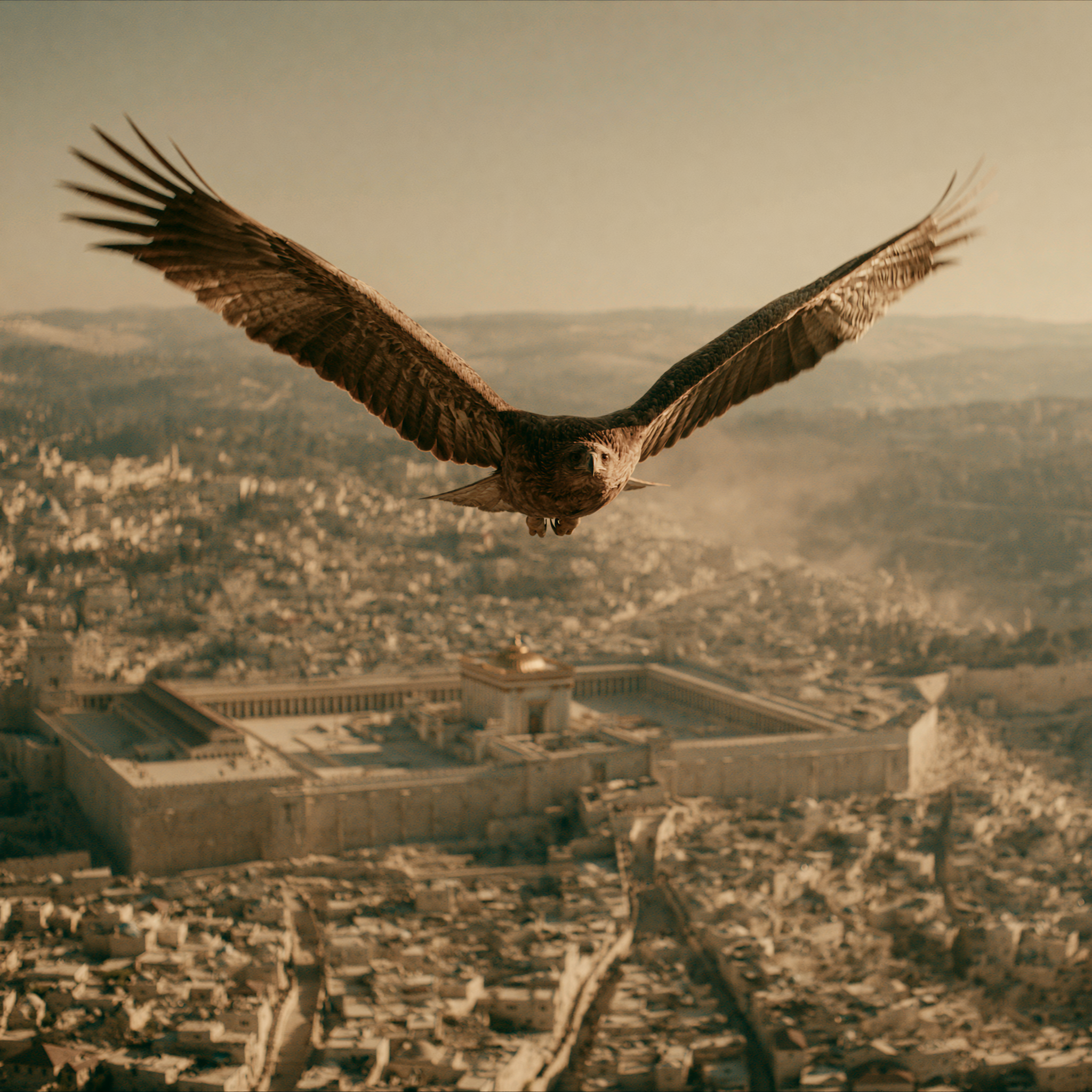
The Christian tradition has long associated each of the four Gospels with one of the four living creatures described in the Book of Ezekiel and the Book of Revelation — a man, a lion, an ox, and an eagle. The assignment varies slightly across different traditions, but the most widespread and ancient gives John the eagle.
The symbolism is precise. The eagle flies higher than the other creatures. It sees from above. It soars where the others walk. And John’s Gospel soars in exactly this way: it begins before creation, it opens with the most compressed and ambitious theological statement in the New Testament, and it sustains a register of theological altitude that the other Gospels do not attempt.
St. Jerome, the great fourth-century biblical scholar, described John as an eagle who flies above the clouds of human weakness and gazes upon the light of unchangeable truth with the most piercing and steady eyes. St. Thomas Aquinas agreed, calling John’s Gospel the most perfect of the four.
The Church reads John’s Gospel at the most theologically significant moments of the liturgical year. The Prologue is read at Christmas. The Farewell Discourse spans the Sundays of Easter. The High Priestly Prayer is read between the Ascension and Pentecost. The Passion narrative, according to John, is read on Good Friday. The Church turns to John when it wants to say the most important things.
Why the Unique Gospel of John Matters for the Modern Reader
Understanding why John is different changes how you read it.
If you come to John expecting the same experience as Matthew, Mark, or Luke, you will be disoriented — where are the parables, why does Jesus sound different, why aren’t these stories in the other Gospels? But if you come knowing that John wrote last, chose deliberately, and is making a theological argument that the others do not make in the same way, you read with different eyes.
You notice the signs and ask what they signify. You hear the I AM statements and feel their weight. You follow the conversations into their depths. You sit with the Farewell Discourse and let the intimacy of it land. You reach the end — these things are written so that you may believe — and understand that the whole book has been addressed to you personally.
Where the Synoptics show you what Jesus did, John shows you who Jesus is.
The four Gospels are not four accounts of the same story told in different styles. They are four portraits of the same person, each capturing something the others do not. Matthew shows you the Messiah. Mark shows you the servant. Luke shows you the friend of sinners. And John shows you the eternal Word of God, made flesh, dwelling among us.
Full of grace and truth.