The Beloved Disciple in the Gospel of John: Identity, Eyewitness Witness, and Enduring Faith
He is the only character in the Gospel of John who never tells you his name.
He appears without introduction, referred to simply as the disciple whom Jesus loved. He reclines next to Jesus at the Last Supper. He stands at the foot of the cross. He outruns Peter to the empty tomb and is the first to believe. He recognizes the risen Christ on the shore of the Sea of Tiberias before anyone else does. And at the very end of the Gospel, he steps out of the narrative entirely and says, in his own voice: this is the disciple who testifies to these things and has written them, and we know that his testimony is true.
He wrote the book. And he wrote himself out of it. Or rather, he wrote himself into it in the strangest possible way — not as a named person with a biography, but as a relationship. Not who he is, but how Jesus regarded him. The disciple whom Jesus loved.
No other figure in the New Testament introduces themselves this way. No other writer describes their own presence in the events they are recording by reference to the love of the person at the center of those events. It is either the most self-effacing authorial gesture in the history of religious writing, or the most quietly confident, or both.
For 2,000 years, scholars have debated who he was. John’s Gospel, deliberately and persistently, declines to say. What it gives us instead is a figure defined entirely by proximity and love — the one who was closest to Jesus, who saw the most, who stayed the longest, and who understood, perhaps earlier than anyone else, what it all meant.
The Beloved Disciple: At a Glance (Summary & Quick Facts)
-
An unnamed disciple of Jesus, referred to throughout the Gospel as the one whom Jesus loved; identified by the early Church with John the Apostle, son of Zebedee
-
The eyewitness behind the fourth Gospel; present at the Last Supper, the crucifixion, the empty tomb, and the resurrection appearances
-
The Upper Room, the courtyard of the high priest, Golgotha, the garden tomb, the Sea of Tiberias
-
Appears first at the Last Supper in chapter 13; present through the Passion, resurrection, and epilogue
-
He is the eyewitness foundation of the entire Gospel — the one who saw and has written it down, whose testimony the community declares to be true
Who Was the Beloved Disciple? The Mystery Behind John’s Unnamed Author
The beloved disciple is one of the most discussed figures in New Testament scholarship, and the discussion has not produced a consensus. The early Church, almost universally, identified him as John the Apostle, son of Zebedee — one of the inner circle of three, present at the Transfiguration, the raising of Jairus’ daughter, the agony in Gethsemane. The tradition behind this identification is early and widespread, and it is the position the Catholic Church has consistently held.
The argument for this identification runs through absence as much as presence. John, the son of Zebedee, is never mentioned by name in the fourth Gospel, though he is named in all three Synoptics and was a central figure in the early Church. If he is the author, his absence by name is explicable — he has replaced his own name with a description of his relationship to Jesus. If he is not the author, his complete absence from a Gospel written by someone in the same circle is harder to explain.
There have been other proposals across the centuries — Lazarus, whom John explicitly tells us Jesus loved, has been suggested; so has an otherwise unknown disciple of the inner circle. But none of these alternatives has displaced the traditional identification. Augustine and Co. follows the Catholic tradition: the beloved disciple is John the Apostle, son of Zebedee, the author of the fourth Gospel, writing himself into his own account under the title that mattered most to him.
Not who he was. How Jesus loved him.
The Beloved Disciple in the Key Scenes of the Gospel of John
Rather than providing a standard biography, the Gospel defines the Beloved Disciple entirely through his presence at its most pivotal moments. Across these key scenes—from the quiet intimacy of the Last Supper to the dawning realization at the empty tomb—we encounter a figure whose identity is rooted solely in his proximity to Christ. By tracing his steadfast witness through the narrative's climax, John presents not just a historical observer but the ultimate model of what it means to be intimately known and loved by Jesus.
-
John 13:21–26
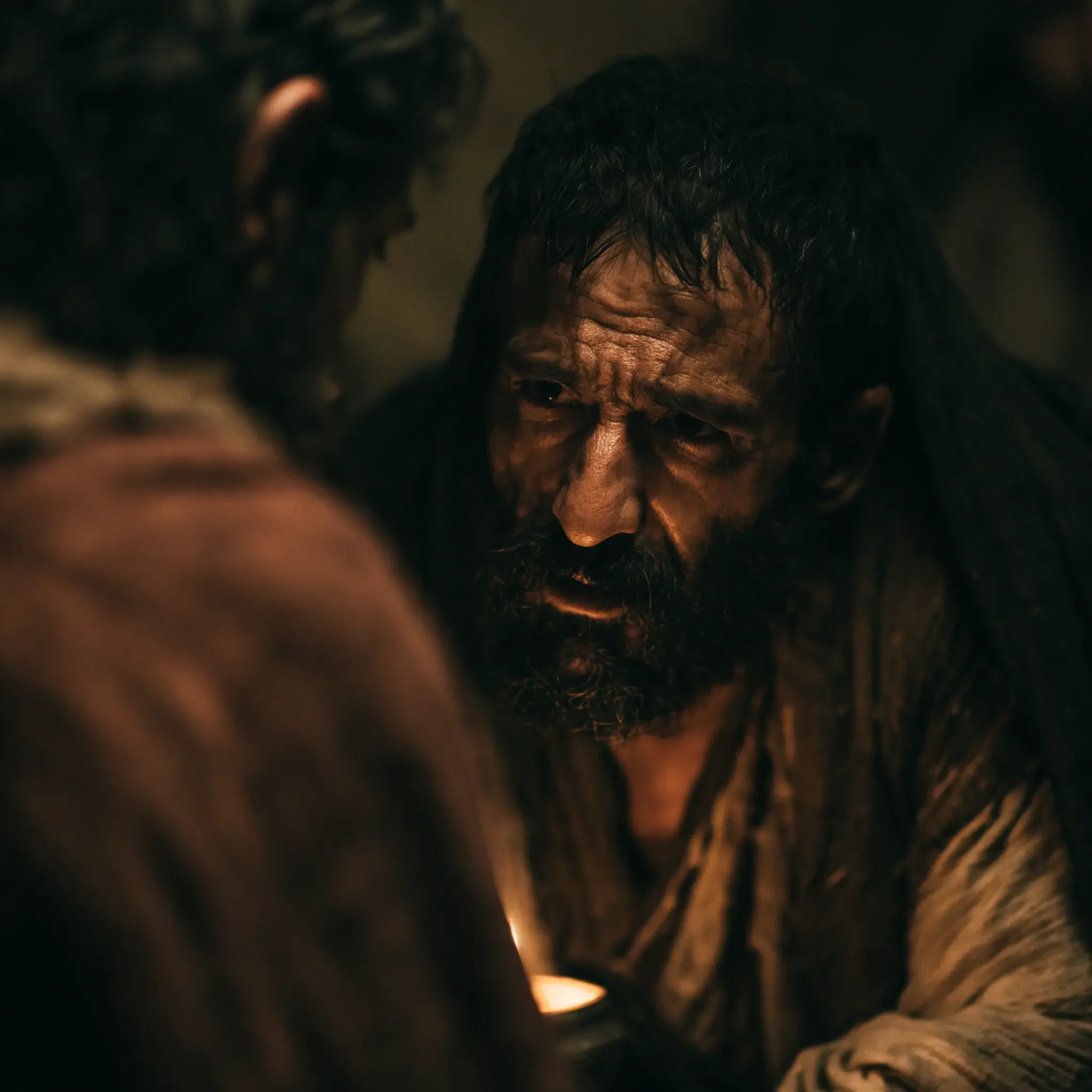
The beloved disciple appears for the first time at the Last Supper, and his introduction is immediate and intimate: he is reclining at table next to Jesus.
The meal has turned dark. Jesus has said that one of them will betray him. The disciples look at one another, uncertain who it could be. Simon Peter signals to the beloved disciple, who is close enough to Jesus to ask Him quietly, and says, “Ask him who he means.”
The beloved disciple leans back against Jesus and asks: “Master, who is it?”
The physical detail matters. He leans back against Jesus. He is that close. Close enough to whisper. Close enough to receive the private answer that Jesus gives — the one to whom I hand the morsel after I dip it.
He is the disciple who is nearest to Jesus at the moment of the announcement. He hears what the others do not. He is the one Jesus trusts with the answer.
This is his introduction in the Gospel: not a name, not a biography, not a list of credentials. A posture. Leaning back against Jesus at the table, on the last night, close enough to ask the question no one else dares to ask.
-
John 18:15–16
After the arrest in the garden, Jesus is led to the high priest. Peter and another disciple follow. John refers to this other disciple without naming him, but the description — known to the high priest, able to gain entry to the courtyard, able to bring Peter in with him — fits the beloved disciple.
If this is him, he is the one who gets Peter through the door. He is inside the courtyard while Jesus is being interrogated. He is there for the beginning of what will become the longest night of the disciples’ lives.
Peter, outside at the gate, will deny Jesus three times before the rooster crows. The beloved disciple, inside, stays close. The difference in their proximity that night will matter in the morning, when the beloved disciple will be the first to believe at the empty tomb.
-
John 19:25–27
When the male disciples had scattered, the beloved disciple was standing at the foot of the cross.
He is named alongside the women, the mother of Jesus, her sister, Mary, the wife of Clopas, and Mary Magdalene. He is the one male disciple John records as present at the crucifixion. He does not flee. He stays.
And from the cross, Jesus looks down at His mother and at this disciple and entrusts them to each other.
“Woman, behold your son.”
Then to the disciple: “Behold your mother.”
From that hour, John writes, the disciple took her into his own home.
This is one of the most intimate moments in the Passion narrative. Jesus, dying, makes arrangements for His mother’s care. And He entrusts her not to a brother or a cousin or a member of the family, but to this disciple. The one he loved. Who stayed.
The Church has read in this moment something beyond domestic provision — the beloved disciple receiving the mother of Jesus as his own mother, and through him, the whole community of disciples receiving her. It is a scene of adoption and belonging, enacted from the cross, in the last hours of Jesus’ life.
-
John 20:1–8
Mary Magdalene comes to the tomb while it is still dark and finds the stone moved. She runs to tell Simon Peter and the beloved disciple.
They run. The beloved disciple outruns Peter and arrives first. He bends down, looks in, sees the burial cloths lying there, but does not go in.
Peter arrives and goes straight inside. He sees the clothes. He sees the face cloth rolled up separately. He sees.
Then the beloved disciple goes in.
He saw and believed.
John adds immediately: “For they did not yet understand the Scripture that he had to rise from the dead.”
He believed without yet understanding. He saw the empty tomb, the arranged cloths, the absence where the body had been, and something in him recognized what it meant before he had the theological framework to explain it. He believed first. Not because he was the fastest runner, but because proximity and love had attuned him to something the others were still catching up to.
This is the beloved disciple’s great moment in the Gospel. Not a dramatic confession like Thomas'. Not a public proclamation like Mary Magdalene. A private, interior recognition in an empty tomb before dawn. He saw and believed.
-
John 21:1–7
It is the beloved disciple who recognizes Jesus on the shore.
The disciples have been fishing all night and caught nothing. A figure stands on the beach at dawn and calls out. They do not know it is Jesus. He tells them to throw the net on the right side, and they cannot haul it in because of the number of fish.
And the disciple whom Jesus loved says to Peter: “It is the Lord.”
Peter throws himself into the water.
The beloved disciple sees first again. At the tomb he believes first. On the shore he recognizes first. There is a pattern here that John is not drawing attention to but is unmistakably present: the one who was closest to Jesus continues to perceive Him most readily. Love sharpens recognition. Proximity creates a kind of sight that precedes and exceeds ordinary evidence.
-
John 21:20–24
The Gospel ends with a passage that is unlike anything else in the New Testament. After Jesus has restored Peter and given him the charge to feed His sheep, Peter turns and sees the beloved disciple following them. He asks Jesus: “Lord, what about him?”
Jesus says: “What if I want him to remain until I come? What concern is it of yours?”
John notes that this saying spread among the brothers as meaning the beloved disciple would not die. But he is careful to correct the misunderstanding: Jesus did not say he would not die. He said: “What if I want him to remain?”
And then, in a shift that is startling in its directness, the author steps forward:
“It is this disciple who testifies to these things and has written them, and we know that his testimony is true.”
He has been writing himself into the Gospel in the third person, as the disciple whom Jesus loved, for the entire second half of the narrative. Now, at the very end, he steps out of the frame and says: it was me. I was there. I wrote this. And the community around me — the we — knows that what I have written is true.
It is the closest thing to a signature the Gospel contains. Not a name, but a claim. An eyewitness insisting on the truthfulness of what he has written, backed by the community that has read and heard and believed.
What the Gospel of John Teaches Us Through the Beloved Disciple
Ultimately, the Beloved Disciple serves as more than just a historical eyewitness; he is the theological anchor of the entire narrative. By leaving him unnamed and defining him solely by his proximity to Jesus, the Gospel transforms him from a singular historical actor into a universal model for the reader. Through his quiet presence and steadfast loyalty, John emphasizes that the truest foundation for enduring faith lies not in formal authority or status but in a deeply personal, witnessing relationship with the love of Christ.
-
Peter is the leader. He is the one Jesus commissions on the beach, the one who receives the threefold charge. The beloved disciple is not the leader. He is the one Jesus loved. And throughout the Gospel, love proves to be a more reliable guide than position.
The beloved disciple believes at the tomb before Peter does. He recognizes Jesus on the shore before Peter does. He is present at the cross when Peter is in a courtyard denying. He is not better than Peter. He is differently situated — defined by his relationship to Jesus rather than his role among the disciples.
John is not setting the beloved disciple against Peter. The final chapter makes clear that both have essential roles: Peter the shepherd, the beloved disciple, the witness. But the Gospel consistently shows that proximity to Jesus — the leaning back at the table, the standing at the foot of the cross, the running to the empty tomb — produces a kind of perception and understanding that office and authority alone cannot give.
-
The beloved disciple’s final testimony — this is the disciple who testifies and has written these things, and we know his testimony is true — is John’s answer to the question every reader of this Gospel eventually asks: how do you know?
The answer is: someone was there. Someone who was at the table when Jesus identified his betrayer, who stood at the cross and saw the blood and water flow, who ran to the empty tomb and saw the burial cloths, who recognized the risen Christ on a beach at dawn. Someone who was in the room saw with his own eyes and wrote it down.
The beloved disciple is the chain of custody between the events of the Gospel and the reader of the Gospel. He is the reason John’s testimony can be trusted. Not because he is infallible, but because he was there.
-
There is something profound about a man choosing to identify himself, in his own account of the most important events he ever witnessed, not by his name or his role or his accomplishments, but by the fact that Jesus loved him.
It is not self-deprecation. It is the opposite — it is the claim that the most important thing about him, the thing that defines his identity more completely than anything else, is that he was loved by this particular person. To be the disciple whom Jesus loved is not a minor distinction. In John’s Gospel, where love is the governing principle of everything — God so loved the world, love one another as I have loved you, greater love has no one than this — to be named by the love of Jesus is to be named by the center of the universe.
He does not need another name. He has the one that matters most.
The Catholic Tradition: Saint John, the Marian Entrustment, and the Feasts
The Catholic Church has consistently identified the beloved disciple with John the Apostle, son of Zebedee, and has attributed to him not only the fourth Gospel but also three letters — First, Second, and Third John — and the Book of Revelation. This Johannine corpus, if it comes from a single author or community, represents one of the most substantial theological contributions in the New Testament.
The tradition holds that John lived to an extraordinary old age — dying in Ephesus in the late first century, the only one of the twelve apostles to die of natural causes rather than martyrdom. This connects to the saying that spread through the early community: the Lord wanted him to remain. He remained. He outlived the other apostles, carried the memory of the events he had witnessed, and eventually wrote them down.
His feast day is December 27, three days after Christmas — a placement that is theologically significant. The Church celebrates the birth of Jesus on December 25, the first martyr Stephen on December 26, and the beloved disciple on December 27. The one who loved and was loved, who stayed when others fled, who took the mother of Jesus into his own home — he is celebrated in the days immediately following the birth of the one whose love defined him.
Mary, entrusted to the beloved disciple from the cross, is understood in Catholic tradition as entrusted not just to one man but to the Church. The beloved disciple receiving her is the Church receiving her. When he takes her into his own home, the home of the Church opens to receive the mother of its Lord.
This reading gives the scene at the foot of the cross a weight that goes far beyond domestic arrangement. Jesus, in His dying moments, is not just making sure His mother is cared for. He is establishing a relationship between the community of His disciples and His mother, one that the Church has treasured and developed over two thousand years.
Why the Story of the Beloved Disciple Matters for Readers Today
There is a quiet invitation in the beloved disciple’s self-description.
He does not call himself John. He does not call himself the son of Zebedee, or the apostle, or the evangelist, or the elder. He calls himself the disciple whom Jesus loved. And in doing so, he opens the description to every reader who has ever felt, in however incomplete or uncertain a way, that Jesus loves them.
The title "beloved disciple" is not exclusive. It is offered. If to be a disciple of Jesus is to be loved by Jesus — and John’s Gospel argues on every page that this is exactly what it means — then the beloved disciple’s name belongs to everyone who follows.
He saw and believed. He recognized the risen Christ on a shore at dawn. He stayed at the foot of the cross. He leaned back against Jesus at the table and asked the question no one else dared to ask.
He was the disciple whom Jesus loved.
And he wrote this Gospel so that you might be too.
“These are written so that you may believe that Jesus is the Christ, the Son of God, and that through this belief you may have life in his name.”
He was there. He saw it. He wrote it down.
The rest is what we do with it.