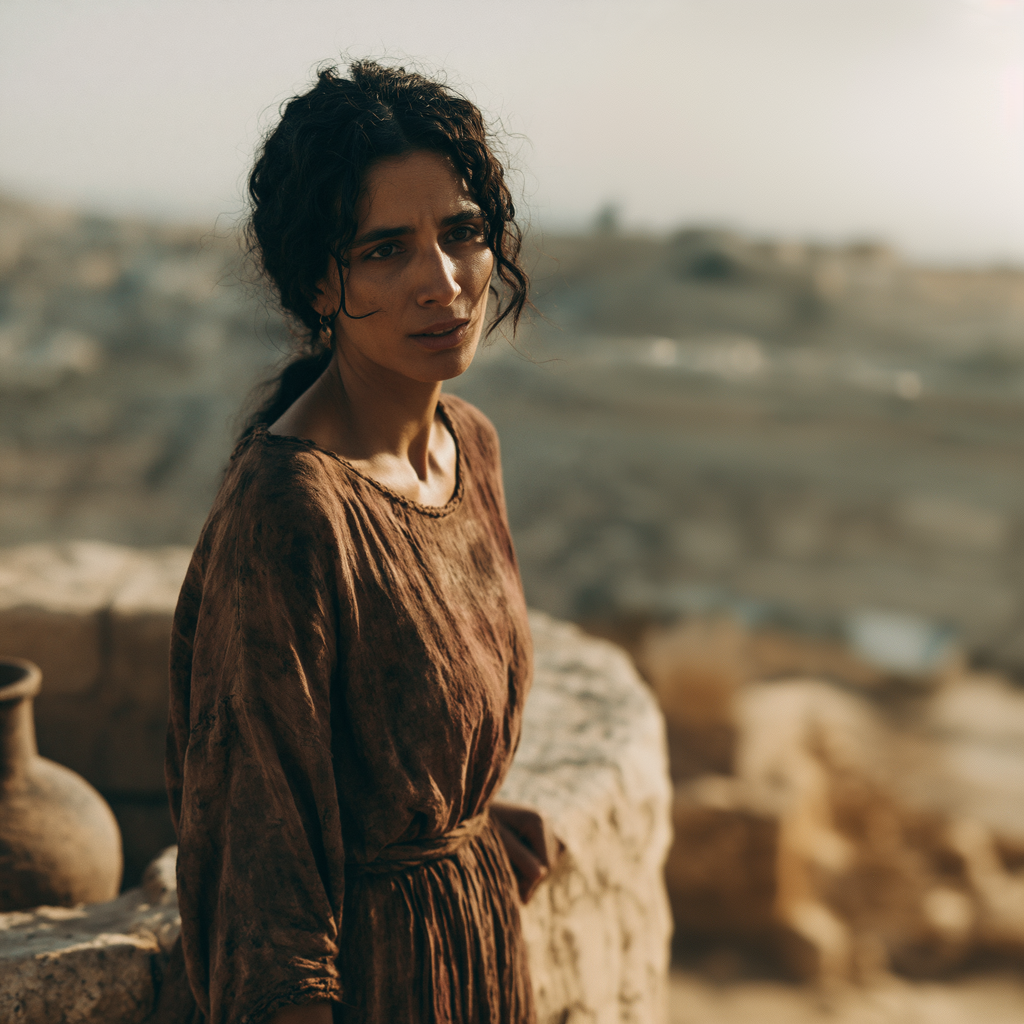
She comes to the well at noon, and John does not tell us her name.
That silence is the first thing to notice. Nicodemus is named. Martha and Mary are named. Even the minor figures of the Passion — Malchus, the servant whose ear is cut off in the garden — receive names in this Gospel. But the woman at Jacob’s well remains unnamed from her first line to her last, and the effect is strange and generous at once. She is a particular woman, in a particular place, at a particular hour. And she is also every person who has ever come to draw water from a well that could not quite satisfy.
What happens between her and Jesus is one of the longest private conversations recorded in any Gospel. It crosses every line the ancient world drew: between Jew and Samaritan, between man and woman, between teacher and stranger. It moves from a request for a drink of water to a claim about the nature of worship to a plain statement of identity that Jesus makes to almost no one else in the Gospel.
And it ends with a water jar abandoned in the dust.
At a Glance: The Samaritan Woman at Jacob’s Well
-
An unnamed Samaritan woman who meets Jesus at Jacob’s well near the town of Sychar
-
The recipient of one of the longest and most theologically rich conversations in John’s Gospel; the first person in the Gospel to bring a whole community to Jesus
-
Jacob’s well at Sychar, in Samaria, on the road between Judea and Galilee
-
About noon, early in Jesus’ public ministry
-
She is the Gospel’s first evangelist, and her encounter with Jesus opens the Gospel’s vision of salvation to the whole world
The Unnamed Woman at Jacob’s Well
To understand why this meeting is surprising, you need to understand what Samaria was.
The Samaritans were a people with a shared history and a shared claim. They revered the Law of Moses. They worshipped the God of Israel. They looked for a coming restorer. But they had been separated from the Jews for centuries, and the separation had hardened into suspicion. The Samaritans worshipped on Mount Gerizim; the Jews worshipped at the Temple in Jerusalem. Each community regarded the other’s worship as mistaken. John puts the whole situation in a single aside: Jews have nothing in common with Samaritans.
So when a Jewish teacher sits down at a Samaritan well and asks a Samaritan woman for a drink, He has already done something remarkable. He has accepted a cup from a hand His own community would have considered unclean. He has begun a conversation with a woman alone, in public, at midday. John does not comment on any of it. He simply lets the scene unfold, and lets the reader notice.
The place matters as much as the people. The well is Jacob’s well, near the plot of ground that Jacob gave to his son Joseph. It belongs to the oldest memory shared by Jews and Samaritans alike. Jesus sits down beside the place where the two peoples’ stories still meet and begins to speak into the division.
Crossing Cultural Boundaries: Jesus and the Samaritans
It is the sixth hour — noon — and Jesus is tired from the road. His disciples have gone into the town to buy food. He sits down at the well alone.
A woman comes to draw water. John does not explain why she comes at midday, when the heat is at its height. The usual hours for drawing water were the cooler parts of the day, and some readers have heard in her timing a sign that she was avoiding the other women of the town. John never says so. What he tells us is simply that she comes, alone, at noon.
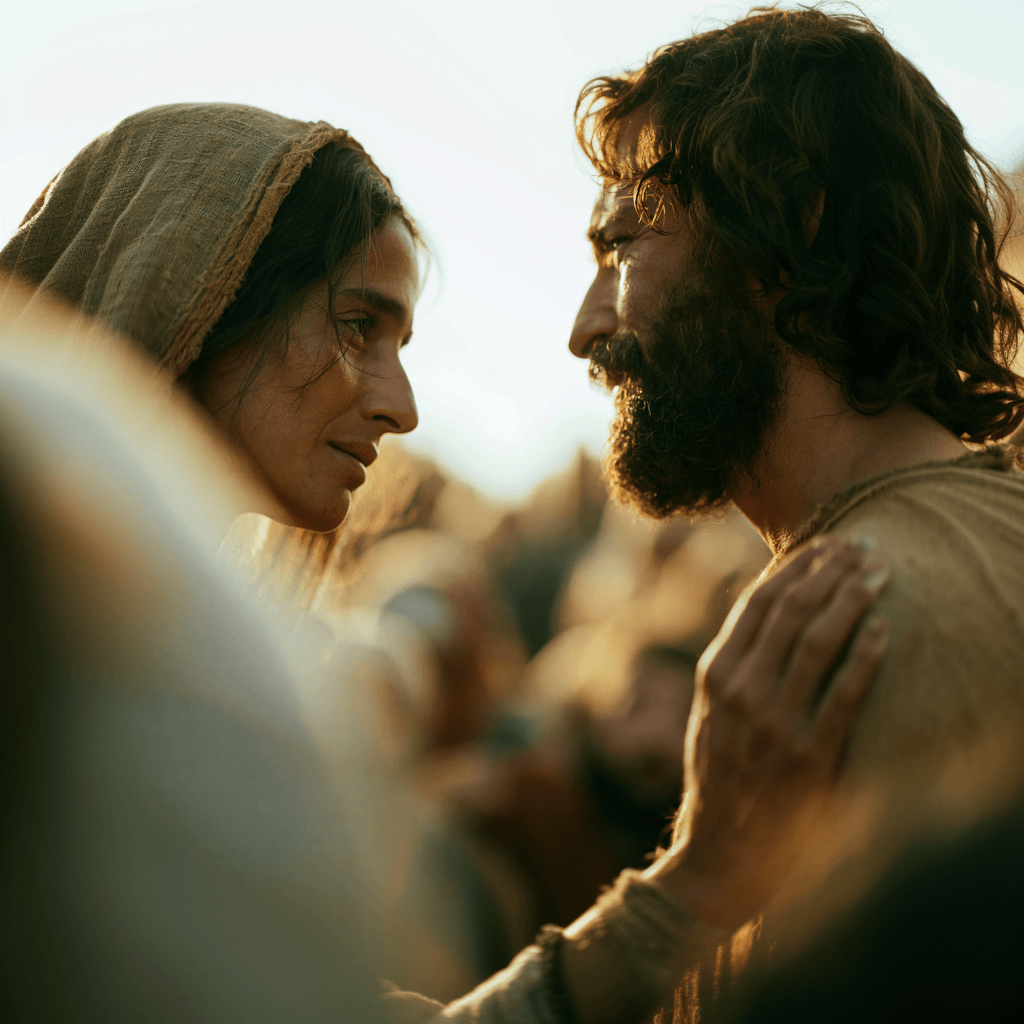
Jesus asks her for a drink.
She is startled, and her answer is the first sign of her character: quick, direct, unafraid. How can you, a Jew, ask me, a Samaritan woman, for a drink? She names the barrier out loud. She does not pretend it is not there.
Jesus does not answer her objection. He answers the question beneath it. If you knew the gift of God and who is saying to you, give me a drink, you would have asked Him and He would have given you living water.
She takes the words literally, and she takes them seriously. You do not even have a bucket, and the cistern is deep. Where would you get this living water? Are you greater than our father Jacob, who gave us this cistern? It is a good question. It is also, without her knowing it, the question the whole Gospel is asking.
And Jesus says: Everyone who drinks this water will be thirsty again; but whoever drinks the water I shall give will never thirst; the water I shall give will become in him a spring of water welling up to eternal life.
She answers with the plainest request in the Gospel: Sir, give me this water, so that I may not be thirsty or have to keep coming here to draw water.
She does not yet understand. But she asks. That is where everything begins.
"Go Call Your Husband": Being Fully Known
The conversation turns abruptly. Go call your husband and come back.
She says: I do not have a husband.
Jesus says: You are right in saying, I do not have a husband. You have had five husbands, and the one you have now is not your husband. What you have said is true.
There is no condemnation in the text. John does not call her a sinner. Jesus does not tell her to repent, nor does He leave. What He does is name her life without flinching, and the effect is the opposite of a rebuke. She is known. Fully, specifically, and without being sent away. Some of the early Church writers also read the five husbands as a symbol, heard against the history of Samaria and the five foreign peoples whose gods had once been worshipped there. Whether the detail is biography or symbol or both, what matters in the scene is the same: she is seen, and she stays.
She does what people do when they have been truly seen. She changes the subject to something larger. Sir, I can see that you are a prophet. Our ancestors worshipped on this mountain; but you people say that the place to worship is in Jerusalem.
It is the question that has divided her people from His for generations, and she asks it of a stranger at a well. Jesus does not take a side. He lifts the question out of geography entirely.
Believe me, woman, the hour is coming when you will worship the Father neither on this mountain nor in Jerusalem. The hour is coming, and is now here, when true worshipers will worship the Father in Spirit and truth; and indeed the Father seeks such people to worship him.
The Father seeks such people. In a Gospel full of people seeking Jesus, here is a sentence that turns the direction around: God is the one seeking.
She answers with the thing her people have always said, the thing that has held them through centuries of waiting: I know that the Messiah is coming, the one called the Christ; when he comes, he will tell us everything.
And Jesus says what He says plainly to almost no one else in the Gospel:
“I am He, the one speaking with you.”
The Greek behind those words is ego eimi — I AM. It is the same phrase that will appear in the seven great declarations later in the Gospel, the same divine name given to Moses at the burning bush. Before He says it to a crowd, before He says it to the disciples, before He says it to the authorities, He says it to a Samaritan woman at a well at noon.
Leaving the Water Jar: Testimony and Evangelization
The disciples return and are astonished to find Him speaking with a woman. John notes that none of them asks what He wants or why He is talking with her. The scene has moved beyond their questions.
And the woman does something John records with a single, quiet detail.
She left her water jar and went into the town.
The jar is the reason she came. It is the errand, the daily labor, the thing she carried to the well. And she leaves it, because she has found something that makes the errand beside the point. She does not go back for it. She runs to the town she has perhaps been avoiding, and she says to the very people she may have kept away from: Come see a man who told me everything I have done. Could He possibly be the Christ?
Notice the shape of her testimony. She does not claim to be certain. She asks a question, and the question is an invitation. Come see. It is the same invitation Philip gave Nathanael in chapter one. It is the entire method of evangelization in John’s Gospel: not argument, but encounter.
They go out of the town and come to Him. And John tells us the result: many of the Samaritans of that town began to believe in Him because of the word of the woman who testified.
Because of her word. She is the first person in the Gospel of John whose testimony brings a whole community to Jesus.
They ask Him to stay with them, and He stays two days. And then comes the line that completes her story:
“It is no longer because of your word that we believe, for we have heard for ourselves, and we know that this is truly the savior of the world.”
It is the perfect result of good testimony. She pointed. They came. They heard for themselves. Her word opened the door, and then she stepped aside so they could meet Him directly. And the title they give Him at the end — savior of the world — is spoken by Samaritans, outsiders, the people the religious establishment of Jerusalem had written off.
Theological Themes: What John Reveals Through the Encounter
Beyond the narrative of the well, John's Gospel weaves a deeper theological tapestry, revealing how human thirst, divine grace, and public testimony intersect in the person of Christ.
-
The conversation begins with a request for water from the one who is thirsty, and it moves, by degrees, to the thirst underneath thirst. She is not told her thirst is foolish. She is told it is real, and that it can be met. The Gospel takes human longing seriously. It does not scold it. It answers it.
-
Everything about this scene pushes outward. A Jew speaks to a Samaritan. A teacher speaks to a woman. The question of where to worship is lifted beyond every mountain and every temple. And the scene ends with the Gospel’s first great title for Jesus on Gentile lips: savior of the world. John is showing his readers, early in the story, what the whole Gospel will argue: the one who comes is not for one people only.
-
Her witness is imperfect and unfinished. She does not know everything. She asks a question rather than making a declaration. And it is enough. She points, and the people come, and they find for themselves what she could only gesture toward. It is the pattern of every faithful witness since: not to replace the encounter, but to lead others to it.
The Catholic Reading: Lent, Baptism, and St. Augustine
The Church has loved this encounter and has placed it at the very heart of Lent.
In Year A of the Sunday lectionary, the Gospel for the Third Sunday of Lent is the story of the Samaritan woman at the well. The Church chooses it deliberately, as the first of three great Johannine scenes — the woman at the well, the man born blind, and the raising of Lazarus — that are read in the weeks leading to Easter. Together they tell the story of what Baptism gives: living water, sight, and life. In parishes that welcome catechumens, these Gospels accompany the scrutinies, the prayers of the Church for those preparing to be baptized at the Easter Vigil. The woman who asked for water to quench her thirst stands beside every person coming to the font.
St. Augustine preached on this passage with particular warmth. He read the woman as a figure of the Church drawn out of the nations, coming to the well to find what she did not know she was seeking. In his hands, the scene becomes an image of the soul’s journey: arriving on an ordinary errand and being met by the one who has been waiting.
The Catechism of the Catholic Church begins its treatment of prayer with this very encounter. It points to the woman at the well as an image of the meeting between God’s thirst and ours: that prayer is the encounter of God’s thirst with ours, and that it is God who thirsts to be thirsted for (CCC 2560).
The Eastern Christian tradition goes further, giving her a name. In the Byzantine tradition, she is called Photina, a name derived from the Greek word for light, and is remembered as a saint who carried the Gospel far beyond Samaria. The name does not come from John, but it reflects a long instinct of the Church: that someone who ran into a town with a question and an invitation could not have stopped there.
Why Her Story Matters
There is a kind of person who is easy to overlook: the one who comes at the hour no one else comes, who carries the daily weight alone, who has learned not to expect much from a conversation with a stranger.
Jesus sits at the well and waits for her.
He does not wait for her to become respectable. He does not wait for her to resolve her history or settle her questions about Gerizim and Jerusalem. He asks her for a drink, and in asking, honors her with a request. And when she is ready, He tells her who He is.
She leaves the jar. She runs. She asks a question that becomes an invitation, and a town comes out to meet Him.
The whole Gospel is in that movement: thirst, encounter, testimony, a world that comes to see for itself.
“Come see a man who told me everything I have done. Could He possibly be the Christ?”
She did not know everything. She asked the question anyway.
It is still enough.