Doctors of the Church
The Catholic Church has given exactly thirty-eight people a title that has nothing to do with medicine. A Doctor of the Church is a teacher — someone whose writing shaped how the faith understands itself, judged eminent enough in learning and holiness that the Church formally says: read this one closely.
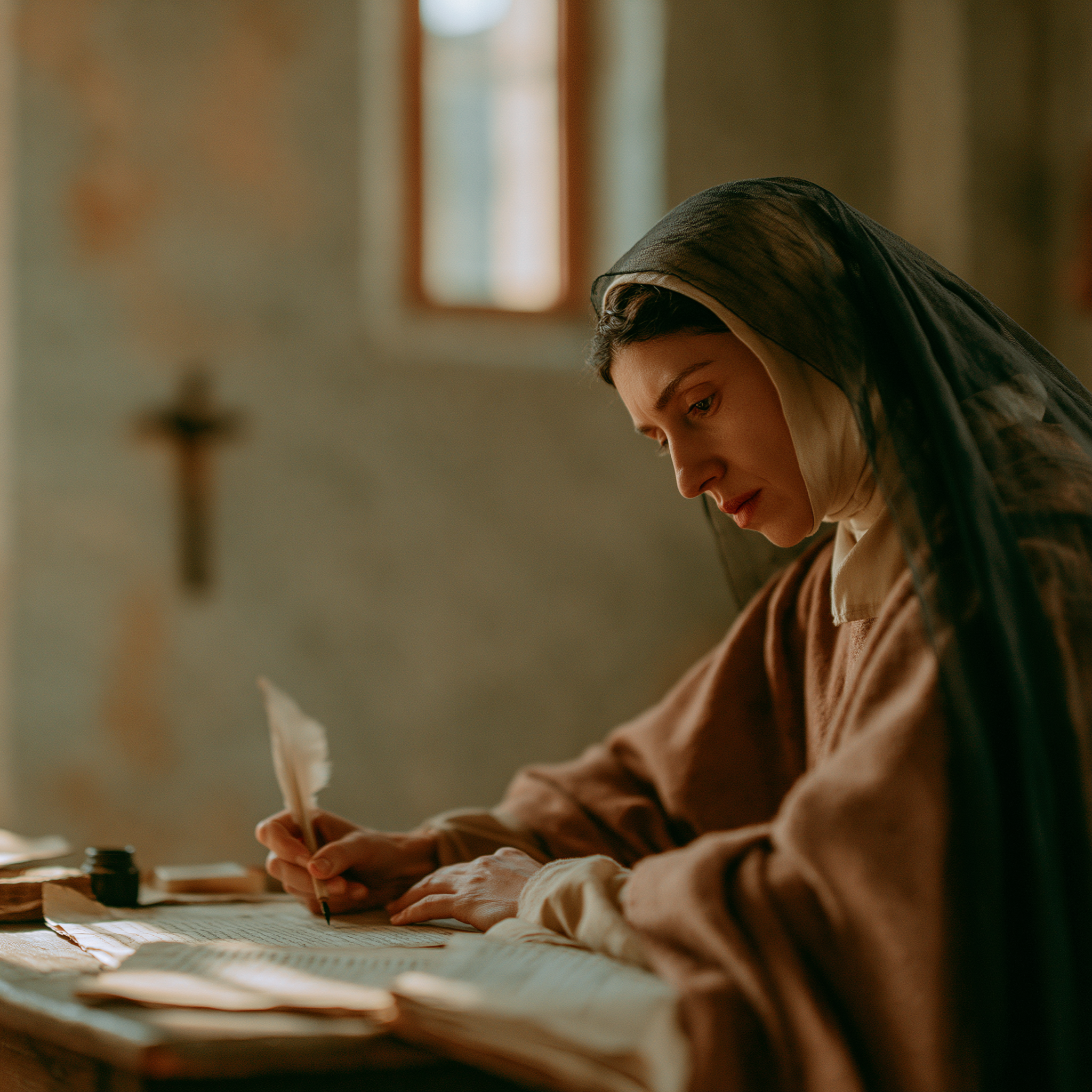
The Architects of Sacred Wisdom
Doctors of the Church
It is the rarest formal title a saint can receive, and the most varied. This category holds a fifth-century bishop who spent his youth running from God, a thirteenth-century friar famous for finding lost things, two Carmelite mystics four centuries apart who both wrote from the inside of prayer, and a Dominican laywoman who told a pope, quite directly, to go back to Rome. Different centuries, different countries, wildly different voices — united only by a Church that read what they wrote and decided it still mattered.
Meet the Saints

DOCTORS OF THE CHURCH

A Doctor isn't declared for being right about everything. A Doctor is declared for teaching the Church something it needed to hear, in a way it couldn't unhear.
-
Doctor of Pastoral Care | Pope who reformed the liturgy and defined early medieval pastoral leadership.
-
Doctor of Bishops | Defender of orthodoxy against Arianism and spiritual mentor to Augustine.
-
Doctor of Grace | Pillar of Western Christian theology, author of Confessions and The City of God.
A towering intellect of the ancient world whose restless pursuit of truth led him from worldly ambition to radical conversion, Saint Augustine of Hippo became the foundational architect of Western Christian thought. Serving as bishop in North Africa amid the collapse of the Roman Empire, he defended the primacy of divine grace in monumental works like Confessions and The City of God, shaping the theological landscape for more than a millennium.
Trace the Path from Milan to Hippo: The Making of Saint Augustine →
-
Doctor of Sacred Scripture | Renowned ascetic scholar who translated the Bible into Latin (the Vulgate).
-
Father of Orthodoxy | Staunch defender of Christ's divinity and the Nicene Creed.
-
Doctor of Monasticism | Cappadocian Father who shaped Eastern monasticism, social charity, and the theology of the Holy Spirit.
-
The Theologian | Cappadocian orator whose orations clarified Trinitarian theology.
-
The Golden-Mouthed | Archbishop of Constantinople, revered for his fearless preaching and liturgical reforms.
-
Doctor of Unity | Disciple of Polycarp, early apologist against Gnosticism (Against Heresies).
-
The Hammer of the Arians | Gallic bishop who staunchly defended the Trinity in the West.
-
Harp of the Holy Spirit | Syrian deacon and poet who expressed deep theological truth through hymnody.
-
Doctor of the Catechumenate | Early instructor of converts through his famed Catechetical Lectures.
-
Doctor of the Incarnation | Patriarch who defended Mary’s title as Theotokos (God-bearer) at the Council of Ephesus.
-
Golden-Worded | Bishop of Ravenna celebrated for his concise, pastoral preaching.
-
Doctor of the Papacy | Pope whose Tome established the Christological doctrine of Chalcedon.
-
Doctor of Education | Visigothic bishop and encyclopedist who preserved classical learning through the early Middle Ages.
-
Father of English History | English Benedictine monk, biblical commentator, and chronicler of Anglo-Saxon Christianity.
-
Doctor of the Sacred Images | Syrian theologian and hymnographer who defended the veneration of holy icons.
-
The Watchful Heart | Armenian monk and mystical poet, author of the Book of Lamentations.
-
Doctor of Reform | Benedictine hermit and cardinal who championed rigorous moral renewal within the clergy.
-
Father of Scholasticism | Archbishop who articulated faith seeking understanding (fides quaerens intellectum) and the ontological argument.
-
Mellifluous Doctor | Cistercian abbot, reformer, and mystical theologian renowned for his preaching on divine love.
-
Sybil of the Rhine | Benedictine polymath, visionary mystic, composer, and naturalist.
-
Evangelical Doctor | Franciscan friar known for his scriptural preaching and care for the vulnerable.
Renowned as the "Hammer of Heretics" and the "Evangelical Doctor," Saint Anthony of Padua was an Augustinian canon turned Franciscan friar whose formidable mastery of Scripture and magnetic preaching drew thousands into the open fields of medieval Italy. Remembered as much for his fearless advocacy on behalf of the poor as for his profound contemplative holiness, he remains one of the Christian tradition's most universally beloved intercessors.
The Voice That Stilled Crowds: Follow Saint Anthony’s Journey Across Medieval Europe →
-
Doctor Universalis | Dominican polymath who integrated natural science and philosophy with theology; mentor to Aquinas.
-
Seraphic Doctor | Franciscan minister general and philosopher who wedded rigorous scholastic intellect with affective mysticism.
-
Angelic Doctor | Dominican friar whose Summa Theologiae remains the cornerstone of Catholic philosophical and systematic theology.
-
Doctor of the Church and Counselor of Popes | Dominican tertiary, mystic, and political peacemaker who urged the papacy’s return to Rome.
A Dominican tertiary of fierce mystical depth and uncompromising courage, Saint Catherine of Siena stepped into the turbulent politics of 14th-century Europe to counsel princes and compel the Pope to return from Avignon to Rome. Her monumental mystical work, The Dialogue, alongside hundreds of candid letters, wedded an ardent passion for the Church's renewal with an intimate, consuming love for the crucified Christ.
The Mystic Who Challenged Princes: Follow Catherine’s Remarkable Journey →
-
Apostle of Andalusia | Spanish priest, spiritual reformer, and preacher who influenced a generation of Counter-Reformation saints.
-
Doctor of Prayer | Carmelite reformer, mystic, and master of interior contemplation (The Interior Castle).
A fearless Carmelite reformer and pioneering mystic of sixteenth-century Spain, Saint Teresa of Ávila crisscrossed the country on rough cart tracks to renew the monastic life with poverty, prayer, and sisterly joy. The first woman declared a Doctor of the Church, her masterworks The Interior Castle and The Way of Perfection mapped the terrain of contemplative prayer with unmatched psychological insight and earthy wit.
Rebel, Reformer, and Mystic: Follow Saint Teresa’s Remarkable Journey →
-
The Hammer of Heresy | Jesuit scholar who revitalized Catholic education and catechized Germany.
-
Mystical Doctor | Carmelite poet and reformer who mapped the soul's ascent through the Dark Night of the Soul.
-
Doctor of Church Controversy | Jesuit cardinal and apologist who systematized the theological defense of the post-Tridentine Church.
-
Apostolic Doctor | Capuchin polyglot, scholar, and diplomat who preached across Europe.
-
Doctor of Charity | Bishop of Geneva who made the devout life accessible to everyday lay people in the modern world.
-
Doctor of Moral Theology | Founder of the Redemptorists, renowned for balancing moral rigor with deep pastoral compassion.
-
A brilliant Oxford scholar and the leading voice of the Anglican Oxford Movement, Saint John Henry Newman sacrificed his prestigious academic standing to enter the Catholic Church. Remembered for his motto "heart speaks to heart" (cor ad cor loquitur) and his profound insights into the development of doctrine, he became one of the defining theological voices of the nineteenth century.
-
Doctor of the Little Way | Discalced Carmelite nun who offered a transformative spiritual theology grounded in spiritual childhood and unconditional trust.
Living in quiet obscurity within a Norman cloister, Saint Thérèse of Lisieux radically transformed modern spiritual theology through her "Little Way" of radical trust and childlike surrender to divine love. Dying at just twenty-four, the "Little Flower" left behind a spiritual memoir, Story of a Soul, whose piercing simplicity and profound theological depth earned her the title of Doctor of the Church.
The Secret of the Little Flower: Read How Ordinary Love Moved the World →