Saint Faustina Kowalska: The Apostle of Divine Mercy, The Diary, and the Image of Jesus, I Trust in You
Feast Day: October 5
Also Known As: Helena Kowalska (birth name); Sister Maria Faustina of the Blessed Sacrament
Born / Died: August 25, 1905, Głogowiec, Poland — October 5, 1938, Kraków, Poland, at age 33
Beatified: April 18, 1993, by Pope John Paul II
Canonized: April 30, 2000, by Pope John Paul II — the first saint canonized in the new millennium
Major Work: Diary: Divine Mercy in My Soul, recording her reported visions and conversations with Christ
Legacy: The Divine Mercy devotion, the Chaplet of Divine Mercy, and Divine Mercy Sunday, established as a universal feast of the Church in 2000
Patronage: The Divine Mercy devotion; those suffering mental illness or despair
For two decades after her death, the Vatican itself restricted the very devotion she had spent her short life recording.
Faustina Kowalska died in 1938 largely unknown outside a small circle of sisters and a handful of clergy, having spent most of her convent years doing ordinary domestic work — cooking, gardening, answering the door. What she left behind was a diary, kept at her spiritual directors' insistence, describing an extended series of visions and conversations she reported having with Christ concerning his mercy. Poor early translations and doctrinal uncertainty led Rome to restrict the spread of that devotion for nearly twenty years after her death — before a future pope, who had known her story from his own days as a young priest in Poland, helped clear the way for her eventual canonization as one of the most significant saints of the modern era.
At a Glance: Fast Facts, Feast Day, and Patronage of Saint Faustina
A quick reference to the essential details of Saint Faustina Kowalska’s life, religious vocation, and legacy as the Apostle of Divine Mercy.
-
Helena Kowalska, a Polish nun who took the religious name Sister Faustina
-
A mystic whose reported visions of Christ gave the Church the Divine Mercy devotion, later established as a universal feast
-
Rural Poland, and later convents in Warsaw, Płock, Vilnius, and Kraków
-
1905–1938
-
Because a poorly educated servant girl became the reported instrument of a devotion the Vatican first restricted and later placed at the center of the universal Church's liturgical calendar
A Servant’s Childhood: Helena Kowalska’s Early Life in Poland
Faustina was born Helena Kowalska in rural Poland, the third of ten children in a poor farming family with little money to spare for schooling — she received only about three years of formal education before leaving to work as a domestic servant in her early teens, helping support the family. She described sensing a call to religious life as young as seven years old, but her parents, facing the family's ongoing poverty, initially refused permission for her to enter a convent, and religious communities of the era typically expected a dowry she had no way to provide.
The Vision at the Dance: A Calling to Religious Life in Warsaw
The decisive moment came in 1924, when Helena, nineteen years old, was at a dance in Łódź with her sister. She described seeing a vision of the suffering Christ, who told her to leave immediately for Warsaw and enter a convent. She left the dance that same evening, without telling her family, and traveled to Warsaw to begin seeking admission to religious life.
Several communities turned her away, largely over her continued inability to provide a dowry, and she worked for roughly a year as a domestic servant to save enough money before the Congregation of the Sisters of Our Lady of Mercy finally accepted her in 1925. She took the religious name Sister Maria Faustina of the Blessed Sacrament and made her final vows in 1933.
A Hidden Life: Convent Routine in the Sisters of Our Lady of Mercy
Within the convent, Faustina's assigned duties were entirely unremarkable — she served as a cook, a gardener, and a doorkeeper across several convent houses in Kraków, Płock, Vilnius, and elsewhere. Nothing about her daily, visible life would have marked her as the center of what was, privately, becoming an extraordinary spiritual experience. It is a pattern that recurs across many of the Church's mystics: extraordinary interior encounters unfolding entirely behind the routine, invisible labor of ordinary religious life.
Two Rays from His Heart: The Origin of the Divine Mercy Image
Beginning around 1931, while stationed at the convent in Płock, Faustina reported the pivotal vision that would define the rest of her life. She described Christ appearing to her dressed in white, with two great rays streaming from his heart — one red, representing blood, and one pale, representing water — and instructing her to have an image painted according to what she had seen, inscribed with the words: Jesus, I trust in You.
That image, and the phrase beneath it, became the visual center of what is now known worldwide as the Divine Mercy devotion — among the most widely reproduced sacred images of the modern Catholic Church, printed on prayer cards, hung in homes and parishes, and instantly recognizable to Catholics who may know nothing else about the sister who reported first seeing it.
The Diary: Divine Mercy in My Soul and the Message of Mercy
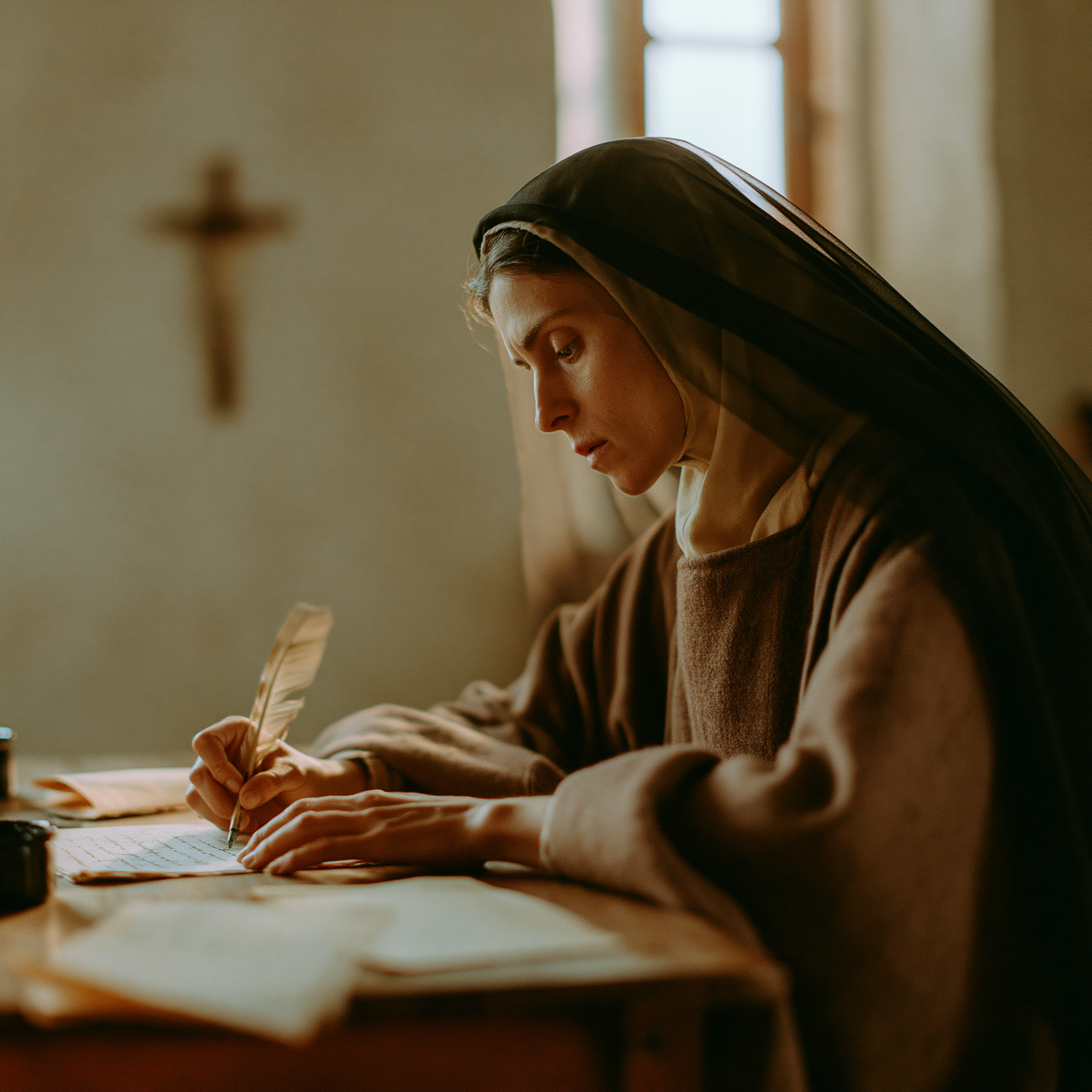
At the direction of her spiritual directors, particularly Father Michael Sopoćko, a priest who became one of her most important supporters and defenders, Faustina kept an extensive diary recording her visions and the messages she reported receiving from Christ. The result, published after her death as Diary: Divine Mercy in My Soul, runs to several hundred pages — a substantial theological and devotional work from a woman with only a few years of formal schooling, dictated almost entirely from her own mystical experience rather than academic training.
From those recorded conversations came the full architecture of the Divine Mercy devotion: the image and its inscription; the Feast of Divine Mercy, to be kept on the Sunday following Easter; the Chaplet of Divine Mercy, a specific prayer said on ordinary rosary beads; and the Hour of Great Mercy, three o'clock in the afternoon, the hour tradition holds Christ died on the cross, to be marked with special prayer.
Doubted and Suppressed: The Vatican’s Twenty-Year Restriction
Faustina's visions met real skepticism during her own lifetime, including doubt from some sisters within her own community and clergy who were not immediately convinced of their authenticity. She endured this doubt alongside worsening tuberculosis, which would eventually kill her at only thirty-three, dying in Kraków in 1938 largely unknown outside the small circle who had come to trust her account.
The skepticism did not end with her death. In 1959, the Holy See placed formal restrictions on the spread of the Divine Mercy devotion and prohibited further distribution of her writings, a decision driven substantially by concerns over inaccurate early translations of the Diary that had introduced doctrinal confusion, compounded by broader uncertainty about the authenticity of her reported visions. For nearly two decades, the devotion Faustina had given her life to recording was effectively suppressed by the very institution she had trusted to carry it forward.
Vindicated by Rome: Pope John Paul II and the Feast of Divine Mercy
The reversal came through the direct involvement of Karol Wojtyła, Archbishop of Kraków, who had long taken a personal interest in Faustina's cause and pressed for a fuller, more accurate re-examination of her writings and reported experiences. The Vatican lifted its restrictions in 1978, the same year Wojtyła was elected Pope John Paul II — and the pope who had helped clear her cause went on, in 1993, to beatify her, and in 2000, on the second Sunday of Easter, to canonize her and formally establish Divine Mercy Sunday as a feast of the universal Church at the very same Mass.
The Catholic Perspective: Trust as the Center of the Divine Mercy Message
Key insights into the Catholic Church’s understanding of Saint Faustina’s writings, the nature of private revelation, and trust as the center of the Divine Mercy devotion.
-
The theology at the heart of Faustina's reported visions is, in its essentials, strikingly simple: that God's mercy exceeds every human sin, and that the appropriate response to that mercy is trust — the very word inscribed beneath the image she was instructed to commission. The devotion built around her writings does not ask for complex theological formation to enter into; it asks for confidence in a mercy the Church teaches has already been offered completely.
-
Faustina's story follows a pattern the Church has seen before with other mystics: genuine doubt and even institutional suppression, followed eventually by careful re-examination and full vindication. It stands as a reminder that the Church's caution around unverified mystical claims, however frustrating for those experiencing them, exists to protect the integrity of what is eventually approved — and that approval, when it finally comes, can carry enormous and lasting consequence, as it did when her feast became one of the most widely observed additions to the modern liturgical calendar.
-
Faustina's Diary stands as a significant work of Catholic spiritual literature produced by a woman with almost no formal education — a reminder, in the same vein as several other saints on this site, that the Church has never required academic credentials as a precondition for genuine spiritual authority.
For nearly two decades, the devotion Faustina had given her life to recording was effectively suppressed by the very institution she had trusted to carry it forward.
Why Saint Faustina Still Matters: The Enduring Power of Divine Mercy
Faustina's life, on its surface, offers little of obvious drama — a poor, undereducated servant girl who became a nun and spent her convent years cooking and gardening, dying young and largely unrecognized. What she left behind, and what the Church eventually spent decades investigating, vindicating, and finally placing at the center of its own liturgical calendar, has become one of the most widely practiced devotions in the entire modern Catholic world.
Her single central message asks for nothing complicated: trust, offered to a mercy the Church holds is already complete and already given. That the message survived skepticism during her own lifetime, formal restriction for two decades after her death, and only reached its fullest expression through the direct intervention of a future pope, has become part of its enduring appeal — proof, to many who have since embraced it, that genuine mercy is not always immediately recognized, but does not depend on being immediately recognized to be real.