Saint Joseph: The Silent Life and Legacy of the Man Who Said Nothing
Feast Days: March 19 (Saint Joseph, Spouse of the Blessed Virgin Mary); May 1 (Saint Joseph the Worker, instituted 1955)
Also Known As: Joseph of Nazareth; the Foster Father of Jesus; the Righteous Man
Born / Died: No date recorded in Scripture or reliable historical record; tradition holds he died before the start of Jesus's public ministry
Canonized: Pre-Congregation — venerated since the early Church; formally declared Patron of the Universal Church by Pope Pius IX in 1870
Patronage: The universal Church; fathers; workers and craftsmen; families; immigrants; a happy death; house-hunters and home-sellers
Major Shrine: Saint Joseph's Oratory, Montreal, Canada — the largest church in Canada and a major pilgrimage site dedicated to him
Saint Joseph never says a single word in the Bible.
Not one line of recorded dialogue, in either Gospel that mentions him. Matthew and Luke tell us what he did — he took Mary into his home, he named the child, he fled to Egypt in the middle of the night, he returned, he searched Jerusalem for three frantic days — but never once do they tell us what he said while doing it. In a religion built substantially on words — the Word made flesh, chief among them — the man entrusted with raising that Word into adulthood is remembered almost entirely through his silence.
It turns out that silence was not absence. It was a particular kind of obedience, the kind that does not need to announce itself, and the Church has spent two thousand years arguing that this quiet, unspeaking man deserves to stand beside his wife and his foster son as one of the most important people who ever lived.
At a Glance: Key Facts About Saint Joseph
Before diving into his life, it helps to see the outline of the man that tradition and Scripture have handed down to us—a quiet framework of facts that anchors a profound story of faith and silent strength. Here is Saint Joseph at a glance.
-
Joseph of Nazareth, a craftsman betrothed and then married to Mary, and the foster father of Jesus
-
The husband of the Blessed Virgin Mary and the man who raised Jesus as his own son, though he was not His biological father
-
Nazareth in Galilee; Bethlehem; Egypt during the flight from Herod; Jerusalem
-
First century BC into the first century AD, contemporary with the birth and childhood of Jesus
-
Because the Holy Family needed a protector who would act immediately and completely on the strength of a dream, without ever demanding an explanation first
The Righteous Man’s Dilemma: Joseph and the Betrothal to Mary
Matthew's Gospel introduces Joseph at the worst possible moment of his engagement. He and Mary are betrothed — a legal bond in first-century Judaism nearly as binding as marriage itself — when he discovers she is pregnant, and the child is not his.
Matthew calls him a righteous man, and then shows us exactly what that righteousness looked like in practice. The law gave Joseph every right to expose Mary publicly, to have her shamed, potentially even stoned. Instead, Matthew tells us, since he was a righteous man, yet unwilling to expose her to shame, he decided to divorce her quietly.
It is a devastating sentence to sit with. Joseph believed, as far as he knew, that his fiancée had been unfaithful to him — and his response was to protect her anyway, at cost to his own reputation, asking for nothing in return. That was his righteousness before an angel ever spoke to him. Then, while he considered this, an angel of the Lord appeared to him in a dream and said: “Joseph, son of David, do not be afraid to take Mary your wife into your home. For it is through the Holy Spirit that this child has been conceived in her.”
Joseph does not argue, question, or ask for a second sign. Matthew simply tells us: when Joseph awoke, he did as the angel of the Lord had commanded him and took his wife into his home.
The Census and the Manger: Leading the Holy Family to Bethlehem
It is Joseph's lineage that brings the Holy Family to Bethlehem. Luke tells us he was of the house and family of David, and so when a census required registration in one's ancestral town, Joseph traveled there with Mary, betrothed to him and about to give birth.
Luke gives Joseph no dialogue in the manger scene either. He is present for the birth in a place with no room at the inn, present for the shepherds who arrive that night describing angels in the sky, present for the naming of the child eight days later according to the law — the name the angel had already given him in the dream. Every step of the infancy narrative that requires a decision, Joseph makes without hesitation, and every step that requires only presence, he simply provides it.
The Flight into Egypt: Protecting the Infant Jesus
The magi's visit sets in motion the most dangerous chapter of Joseph's story. After they depart by a different route, an angel appears to Joseph in a dream a second time and says: “Rise, take the child and his mother, flee to Egypt, and stay there until I tell you. Herod is going to search for the child to destroy him.”
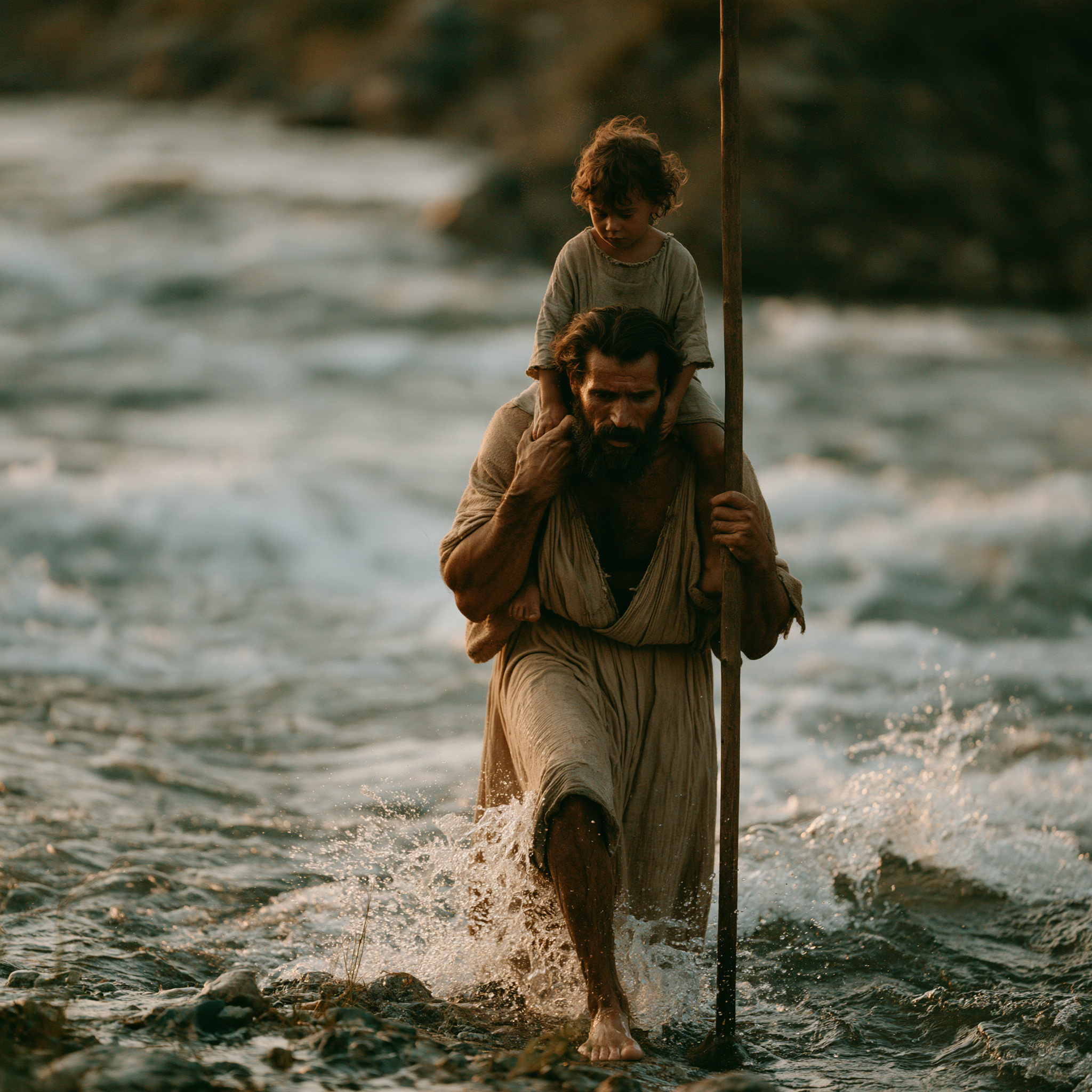
Joseph does not wait for morning. Matthew tells us he rose, took the child and his mother by night, and departed for Egypt — a journey of roughly two hundred miles into a foreign country, undertaken on the strength of a dream, to save a child who was not his by blood. Herod's soldiers, finding themselves outwitted, massacre the infant boys of Bethlehem in an atrocity the Church has never allowed itself to look away from. Joseph's swift, silent obedience is the reason Jesus was not among them.
A third dream comes after Herod's death, telling Joseph it is safe to return, and a fourth redirects him away from Judea and toward Galilee, to Nazareth, out of fear of Herod's son Archelaus. Four dreams, four immediate responses, and not one recorded word of protest, confusion, or complaint in any of them.
Three Days Lost: Finding Jesus in the Temple
Joseph's last appearance in Scripture comes when Jesus is twelve. The family travels to Jerusalem for Passover, and on the return journey, Mary and Joseph realize Jesus is not with the group. They search for three days before finding Him in the Temple, sitting among the teachers, listening and asking questions, and everyone who heard Him was astonished at His understanding and His answers.
It is Mary who speaks in this scene — “Son, why have you done this to us? Your father and I have been looking for you with great anxiety.”
Joseph, as always, says nothing that Luke records. He simply appears in the scene, searching alongside his wife, present for the return home to Nazareth, and then Scripture closes the door on him. He is not mentioned again. By the time Jesus begins His public ministry roughly two decades later, tradition holds that Joseph had already died, most likely in the quiet company of the wife and foster son he had spent his life protecting.
The Carpenter of Nazareth: Saint Joseph’s Trade and Quiet Virtues
The Gospels tell us Joseph's trade: he was a tekton, a Greek word usually translated as carpenter but broader in meaning, covering builders and craftsmen who worked in wood and sometimes stone. It is a detail easy to pass over and impossible to overstate. The Son of God spent the first three decades of His life in the household of a manual laborer, learning a trade, known to His neighbors in Nazareth as the carpenter's son.
There is no Gospel scene of Joseph teaching Jesus his craft. There did not need to be one. The whole of Jesus's hidden life at Nazareth — the eighteen silent years the Gospels pass over in a single verse, that he was obedient to them — took shape inside a household Joseph provided for and ran. Whatever Jesus learned about patience, honest work, and the dignity of an ordinary trade, He most likely learned first at Joseph's side.
The Catholic Perspective: Saint Joseph as Patron of Fatherhood, Workers, and a Happy Death
The Catholic Church honors Saint Joseph not for the words he spoke, but for the life he lived in the shadows of sacred history. In a tradition rich with theologians and martyrs, Joseph stands apart: a quiet tradesman elevated to a guardian of faith through simple fatherhood, honest work, and a grace-filled death.
-
In 1870, Pope Pius IX formally declared Joseph the Patron of the Universal Church, elevating a devotion that had already grown steadily for centuries, championed by saints such as Teresa of Avila and Bernardine of Siena. The reasoning follows directly from his earthly role: the man entrusted with protecting and providing for the Holy Family is entrusted, by extension, with protecting and providing for the family of the Church.
-
In 1955, Pope Pius XII instituted the feast of Saint Joseph the Worker on May 1, deliberately placed opposite the secular May Day, to root the dignity of human labor in a specifically Christian vision — ordinary work as a share in God's own creative activity, sanctified by the example of a carpenter who raised the Son of God between jobs.
-
Catholic tradition holds that Joseph died in the presence of Jesus and Mary, and from that belief grew his patronage over a happy or holy death — the grace of dying at peace, surrounded by those who love you, prepared rather than surprised. It is one of the most quietly comforting patronages any saint carries.
-
Joseph is the Church's primary model of what it means to father a child you did not conceive — to protect, provide for, and love completely on the strength of a calling rather than a biological claim. For adoptive fathers, stepfathers, and foster fathers, his example carries a specific and practical weight that few other saints can offer.
Four dreams. Four immediate departures. And not one recorded word of protest in any of them.
Why Saint Joseph Still Matters: The Spiritual Power of Silent Obedience
It would be easy to read Joseph's silence as passivity, but nothing in his story supports that reading. Every dream he receives demands an immediate, costly, often dangerous action, and every time, Matthew tells us, he simply rose and did it. There is no recorded hesitation, no bargaining, no request for a clearer sign. His obedience is total and nearly instantaneous, which is a much harder thing to sustain than a single dramatic act of faith.
He protected a pregnant fiancée he had every legal right to expose. He fled by night to save a child who was not biologically his. He searched three anguished days for a boy who, when found, seemed unbothered by the search. And then he disappears from the story entirely, having done everything that was asked of him and having asked, as far as the text shows us, for nothing in return.
That is the whole of his sanctity: not a single word, but a lifetime of the right actions taken immediately, quietly, and without any need for credit.